

Small UAV Market Growth to US$ 4.47 Billion by 2035; Driven by AI, Defense Spending, and Advanced Drone Technologies
Small UAV Market
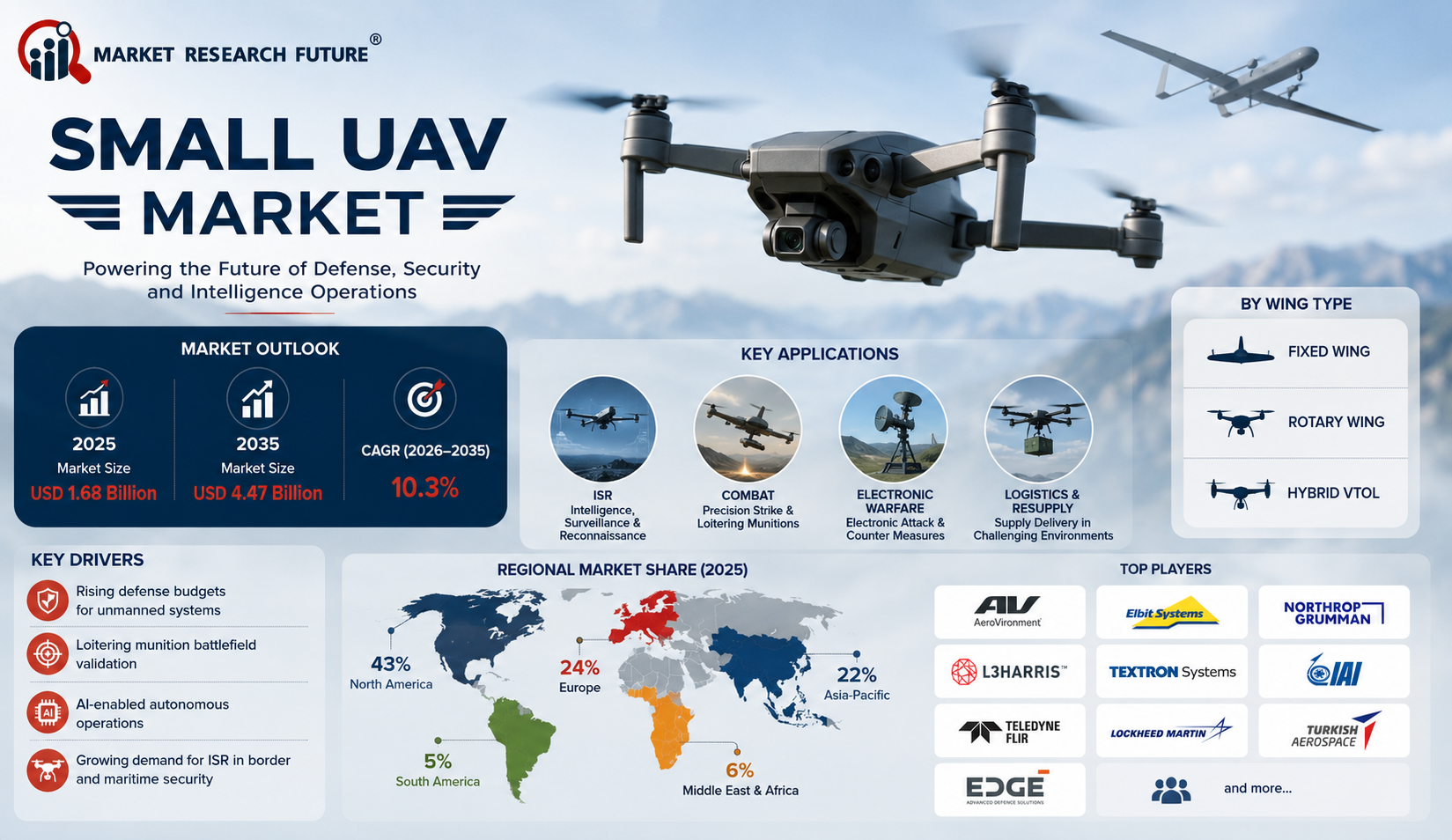
Global small UAV market is projected to grow from USD 1.68 Billion in 2025 to USD 4.47 Billion by 2035, registering a CAGR of 10.3% during 2026–2035.
NEW YORK, NY, UNITED STATES, July 21, 2026 /EINPresswire.com/ -- The Small UAV (Unmanned Aerial Vehicle) Market is witnessing significant expansion, supported by increased defense spending, rapid technological advancements, and the growing need for real-time intelligence capabilities. This growth reflects the increasing deployment of compact UAV systems across ISR, combat, and logistics missions, particularly in modern warfare environments where agility and cost efficiency are critical.Latest Market Trends:
1. Proliferation of Loitering Munitions
Loitering munitions are becoming a defining trend in the Small UAV market due to their ability to combine surveillance and strike functions within a single platform. These systems can remain airborne for extended periods while identifying and engaging targets with high precision. Their effectiveness has been validated in recent conflict scenarios, especially in Europe and the Middle East, where they have demonstrated tactical superiority over traditional systems. Additionally, their relatively lower cost compared to conventional missile systems is encouraging widespread adoption among defense forces.
Request Sample of Report: https://www.marketresearchfuture.com/sample_request/1136
2. Shift Toward Hybrid VTOL Platforms
Hybrid VTOL UAVs are gaining prominence as they integrate the endurance advantages of fixed-wing aircraft with the flexibility of rotary-wing systems. These platforms can take off and land vertically while also achieving long-range horizontal flight, making them highly suitable for missions in remote or infrastructure-limited regions. Their ability to operate without runways while maintaining efficiency is driving increased deployment in border surveillance and maritime monitoring applications.
3. Integration of Artificial Intelligence and Autonomous Systems
Artificial intelligence is transforming the operational capabilities of small UAVs by enabling autonomous navigation, real-time data processing, and swarm coordination. AI-powered systems can analyze large volumes of data during flight, allowing for faster and more accurate decision-making. This reduces reliance on human operators and enhances mission efficiency, particularly in complex and contested environments. Over the long term, AI integration is expected to redefine UAV operations by enabling fully autonomous missions.
4. Miniaturization and Nano UAV Advancements
The demand for smaller UAVs, particularly nano and micro drones, is increasing as military forces seek discreet and portable reconnaissance tools. These UAVs are designed for close-range surveillance in urban and confined environments, offering high-resolution imaging and stealth capabilities. Their compact size allows for easy deployment by individual soldiers, making them indispensable for special operations and tactical missions.
Key Market Drivers:
1. Rising Defense Budgets for Unmanned Systems (~22% Impact)
Global defense organizations are significantly increasing their investment in unmanned systems as part of broader modernization strategies. Small UAVs offer cost-effective alternatives to manned platforms while enhancing operational capabilities. The short procurement cycles associated with these systems allow for rapid deployment, making them highly attractive for immediate defense needs across multiple regions.
2. Loitering Munition Battlefield Validation (~18% Impact)
The demonstrated success of loitering munitions in real-world combat scenarios has accelerated their adoption. These systems provide precise strike capabilities with minimal collateral damage, making them highly effective in modern warfare. Their growing use in Europe and the Middle East is driving short-term demand and influencing procurement strategies globally.
3. Hybrid VTOL Platform Maturation (~15% Impact)
Advancements in hybrid VTOL technology are improving reliability, efficiency, and payload capacity, making these platforms more viable for a wide range of missions. As these systems continue to mature, they are expected to play a crucial role in medium-term market growth, particularly in regions with challenging terrain or limited infrastructure.
4. AI-Enabled Autonomous Operations (~14% Impact)
The integration of AI into UAV systems is enabling autonomous operations that reduce human intervention and improve mission effectiveness. These capabilities are particularly valuable in high-risk environments where real-time decision-making is critical. Over the long term, AI-driven UAVs are expected to become a cornerstone of modern defense strategies.
5. Fuel-Cell Propulsion R&D Advances (~12% Impact)
Ongoing research and development in fuel-cell propulsion are addressing one of the key limitations of UAVs—endurance. Fuel-cell technology offers longer flight durations compared to traditional battery systems, making it suitable for extended ISR missions. This innovation is expected to drive medium-term growth, particularly in North America and Asia-Pacific.
6. ISR Demand from Border & Maritime Security (~10% Impact)
The increasing need for continuous monitoring of borders and maritime regions is driving demand for small UAVs. These systems provide real-time intelligence and enhance situational awareness, enabling governments to respond effectively to security threats. Their deployment is expanding globally as geopolitical tensions continue to rise.
7. Indigenous Production Mandates (~9% Impact)
Many emerging economies are prioritizing domestic production of UAVs to reduce reliance on foreign suppliers. Government initiatives and policy support are encouraging local manufacturing and innovation, creating long-term growth opportunities. This trend is particularly strong in Asia-Pacific and the Middle East & Africa regions.
Emerging Opportunities:
1. Counter-Drone and Electronic Warfare Integration
The growing threat posed by hostile UAVs is creating demand for counter-drone systems integrated with electronic warfare capabilities. Small UAVs equipped with detection, jamming, and neutralization technologies are becoming essential components of modern defense strategies, opening new avenues for market growth.
2. Drone-as-a-Service (DaaS) for Defense Customers
The emergence of Drone-as-a-Service models is enabling defense organizations to access UAV capabilities without significant upfront investment. This approach allows for flexible deployment and scalability, making it particularly attractive for smaller defense agencies or those with budget constraints.
3. Emerging-Market Indigenous Production
Government-backed initiatives in emerging markets are fostering the development of local UAV manufacturing ecosystems. These programs are creating opportunities for technology partnerships, joint ventures, and export-oriented production, contributing to the overall expansion of the market.
Recent Developments:
March 2025 – AeroVironment secured a major contract worth USD 990 million from the U.S. Army for the upgrade of its Switchblade 600 loitering munition system. This development reinforces the company’s leadership in the tactical UAV segment and highlights the growing importance of advanced loitering munitions in modern combat operations.
June 2024 – Teledyne FLIR delivered its 15,000th Black Hornet nano drone, marking a significant milestone in the adoption of micro UAV systems. This achievement underscores the increasing reliance on lightweight and portable drones for tactical reconnaissance and situational awareness in military operations worldwide.
April 2024 – The Indian Ministry of Defence approved a procurement plan worth INR 38 billion under the Production Linked Incentive (PLI) scheme to support indigenous drone manufacturing. This initiative is expected to strengthen domestic production capabilities and reduce dependence on imports, positioning India as a key player in the global UAV market.
Profiles of Top Companies:
1. AeroVironment (~10–13%) - AeroVironment is a leading player in the small UAV market, known for its advanced tactical systems such as Switchblade, Puma, and JUMP 20. The company has established a strong presence in the U.S. defense sector through consistent innovation and long-term contracts, particularly in loitering munition technologies.
2. Elbit Systems (~7–10%) - Elbit Systems offers a comprehensive portfolio of UAV solutions, including Hermes 45, Skylark, and Thor. The company is recognized for its ability to integrate ISR and strike capabilities, making it a preferred supplier for defense forces seeking versatile and mission-ready systems.
3. Northrop Grumman (~5–8%) - Northrop Grumman leverages its expertise as a defense prime contractor to deliver advanced UAV systems such as Bat and Coyote. The company’s focus on counter-UAS technologies and system integration positions it as a key player in the evolving defense landscape.
4. L3Harris Technologies (~4–7%) - L3Harris specializes in sensor and payload integration, offering platforms like FVR-90 and Vector Hawk. Its strong capabilities in communication and surveillance technologies enhance the performance and reliability of its UAV systems.
5. Textron Systems (~4–6%) - Textron Systems focuses on endurance UAV platforms such as Aerosonde and Fury, which are designed for long-duration missions. The company’s emphasis on heavy-fuel propulsion systems provides operational advantages in extended ISR applications.
6. Israel Aerospace Industries (~3–6%) - Israel Aerospace Industries is a pioneer in loitering munition systems, with products like Rotem and Green Dragon. The company’s innovative approach and proven track record in combat scenarios make it a significant contributor to market growth.
7. Teledyne FLIR (~3–5%) - Teledyne FLIR is a leader in nano and micro UAV technologies, offering systems such as Black Hornet and SkyRanger. Its focus on compact and high-performance drones has made it a preferred choice for tactical reconnaissance missions.
8. Lockheed Martin (~3–5%) - Lockheed Martin integrates UAV technologies with its broader defense systems portfolio, offering platforms like Indago and Stalker VXE. The company’s cross-domain expertise enhances the operational effectiveness of its UAV solutions.
9. Turkish Aerospace Industries (~2–4%) - Turkish Aerospace Industries is emerging as a competitive player with cost-effective UAV solutions such as Kargu and Togan. Its focus on export markets and affordability is expanding its global footprint.
10. Edge Group (UAE) (~2–4%) - Edge Group is a rapidly growing defense company in the Middle East, offering UAV systems like the QX series and Shadow 25. Its emphasis on indigenous production and regional capabilities positions it as a key player in the market.
Regional Analysis:
North America (~43%) - North America holds the largest share of the Small UAV market, driven by substantial defense budgets and advanced technological capabilities. Initiatives such as the Pentagon’s Replicator program are accelerating the deployment of unmanned systems, while the expansion of BVLOS corridors is enhancing operational flexibility and adoption.
Europe (~24%) - Europe is experiencing significant growth due to increased defense spending and geopolitical tensions, particularly the ongoing conflict in Ukraine. The region is focusing on strengthening defense autonomy and investing in advanced UAV technologies to enhance its strategic capabilities.
Asia-Pacific (~22%) - Asia-Pacific is emerging as a key growth region, supported by strong investments in indigenous UAV production and modernization of border surveillance systems. Countries such as India and China are leading the adoption of advanced UAV technologies, driving regional market expansion.
South America (~5%) - In South America, the adoption of small UAVs is primarily driven by border security and counter-narcotics operations. Governments are increasingly utilizing UAVs for ISR missions in remote and difficult-to-access areas, improving surveillance capabilities.
Middle East & Africa (~6%) - The Middle East & Africa region is witnessing growth due to the increasing use of UAVs in asymmetric warfare and infrastructure protection. UAVs are being deployed for monitoring critical assets such as oil and gas facilities, contributing to regional market development.
Segment Analysis:
1. By Wing Type
Fixed Wing - Fixed-wing UAVs are widely used for long-endurance missions due to their ability to cover large areas efficiently. These systems are particularly suitable for surveillance and reconnaissance operations where extended flight duration is required.
Rotary Wing - Rotary-wing UAVs provide vertical takeoff and landing capabilities, making them ideal for operations in confined or urban environments. Their maneuverability and ease of deployment make them a preferred choice for tactical missions.
Hybrid VTOL - Hybrid VTOL UAVs combine the strengths of fixed-wing and rotary-wing systems, offering both endurance and operational flexibility. These platforms are gaining traction as they address the limitations of traditional UAV designs.
2. By Size Class
Mini UAVs - Mini UAVs strike a balance between portability and performance, making them suitable for a wide range of tactical applications. They are commonly used by military units for reconnaissance and surveillance missions.
Small UAVs - Small UAVs offer higher payload capacity and extended range, enabling more complex missions such as combat and electronic warfare. Their versatility makes them a key segment in the market.
Nano/Micro UAVs - Nano and micro UAVs are designed for stealth and close-range operations, providing critical intelligence in urban and confined environments. Their increasing adoption reflects the growing need for discreet surveillance tools.
3. By Application
ISR (Intelligence, Surveillance, Reconnaissance) - ISR remains the largest application segment, driven by the need for continuous monitoring and real-time intelligence. Small UAVs play a crucial role in enhancing situational awareness across defense operations.
Combat - Combat applications include strike missions and loitering munitions, which are gaining popularity due to their precision and effectiveness. These systems are transforming modern warfare by providing cost-efficient strike capabilities.
Electronic Warfare - UAVs equipped with electronic warfare capabilities are becoming increasingly important for disrupting enemy communications and systems. This segment is expected to grow as electronic warfare becomes a critical component of defense strategies.
Logistics & Resupply - The use of UAVs for logistics and resupply is expanding, particularly in remote or hostile environments. These systems reduce the risk to personnel and improve operational efficiency by enabling rapid delivery of essential supplies.
4. By Propulsion Type
Batteries - Battery-powered UAVs dominate the smaller segments due to their simplicity and cost-effectiveness. They are well-suited for short-duration missions and are widely used in tactical operations.
Internal Combustion Engine - Internal combustion engines are used in UAVs that require longer endurance and higher power output. These systems are reliable and suitable for extended ISR missions.
Fuel Cells - Fuel-cell propulsion is an emerging technology that offers significant advantages in terms of endurance and efficiency. As development progresses, this segment is expected to gain traction and contribute to market growth.
Conclusion:
The Small UAV market is poised for substantial growth over the forecast period, driven by increasing defense investments, technological innovation, and evolving operational requirements. With advancements in AI, hybrid platforms, and propulsion technologies, small UAVs are becoming indispensable assets in modern defense strategies. The market presents significant opportunities for industry stakeholders, particularly in emerging regions and next-generation UAV technologies.
Browse More Reports:
Fuel Cell UAV Market
https://www.marketresearchfuture.com/reports/fuel-cell-uav-market-27361
Unmanned Aerial Vehicle (UAV) Market
https://www.marketresearchfuture.com/reports/unmanned-aerial-vehicle-uav-market-806
Multirotor UAV Market
https://www.marketresearchfuture.com/reports/multirotor-uav-market-6244
Sagar Kadam
Market Research Future
+1 628-258-0071
sales@marketresearchfuture.com
Legal Disclaimer:
EIN Presswire provides this news content "as is" without warranty of any kind. We do not accept any responsibility or liability for the accuracy, content, images, videos, licenses, completeness, legality, or reliability of the information contained in this article. If you have any complaints or copyright issues related to this article, kindly contact the author above.
