

Permutable Data Shows UK Inflation and Energy Shock Nears 2022 Levels as Pass-Through Stays Limited
Permutable’s latest sentiment data finds that energy now accounts for 42.1% of the UK inflation signal, close to the 42.7% share seen in September 2022, but without the same broadening into food and services. The research suggests the current shock remains concentrated, with limited evidence so far of sustained second-round inflation, even as gilt yields remain elevated
London, LONDON, Sept. 14, 2026 (GLOBE NEWSWIRE) -- Britain’s latest energy shock has reached almost the same concentration in the UK inflation signal as it did in September 2022, but has so far failed to produce the broader inflationary spillover seen four years ago, according to new analysis from Permutable.
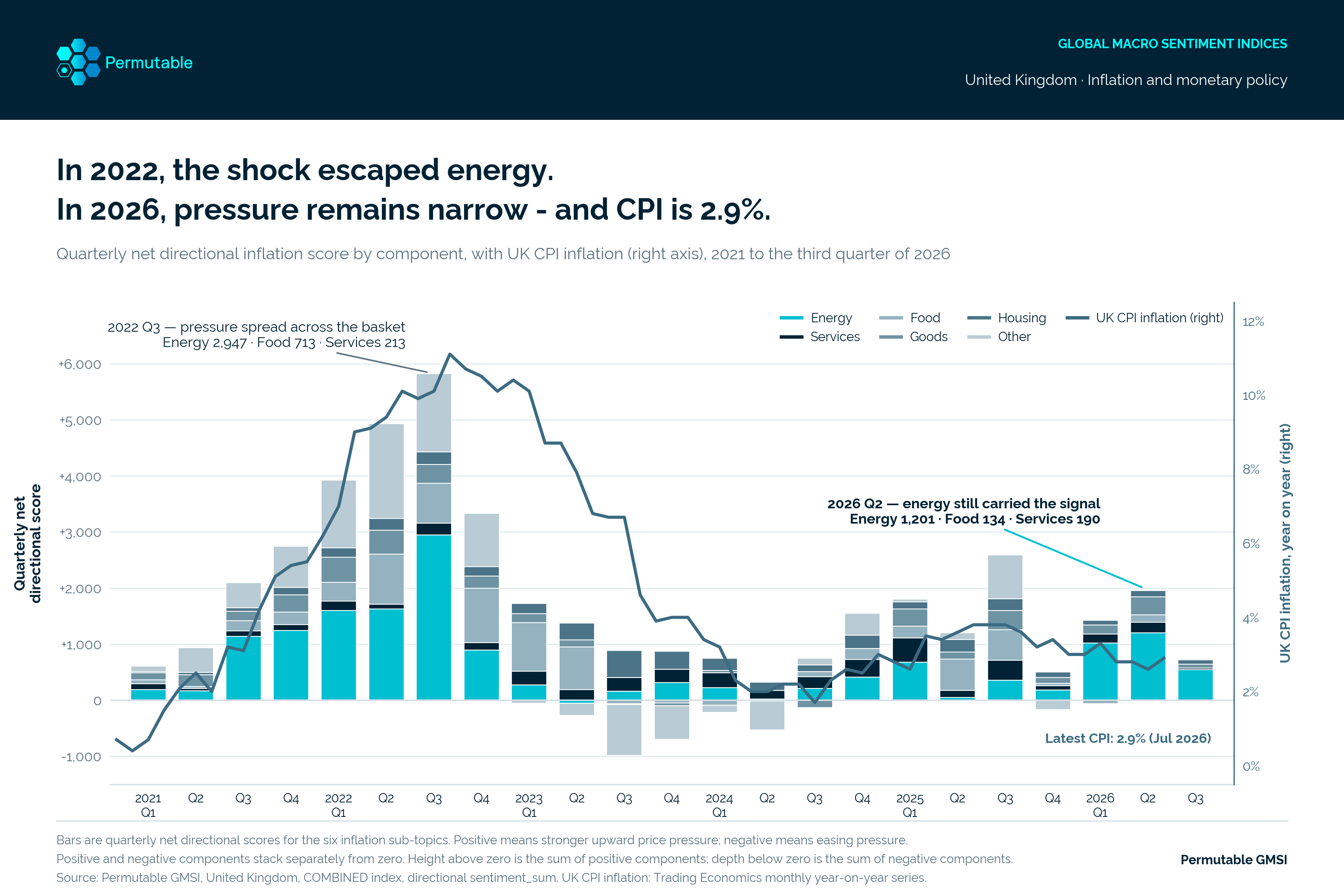
Permutable GMSI recorded energy, food and services scores of 2,947, 713 and 213 respectively in Q3 2022, compared with 1,201, 134 and 190 in Q2 2026, while UK CPI stood at 2.9% in July 2026.
Data from Permutable’s Global Macro Sentiment Indices (GMSI) shows energy accounted for 42.1% of the absolute UK inflation signal on 9 September 2026, compared with 42.7% on the same date in 2022.
The similarity is in concentration rather than the size of the underlying price shock. In 2022, higher energy costs spread rapidly through the inflation basket. This year, the pressure has remained much more heavily concentrated in energy. The difference is clearest in food.
In the third quarter of 2022, Permutable’s directional inflation data recorded a score of 2,947 for energy and 713 for food. In the second quarter of 2026, the equivalent readings were 1,201 and 134 respectively. Services recorded 213 in the 2022 period and 190 in 2026.
More recent data shows little evidence that the energy shock has yet developed into sustained second-round inflation. As of 9 September, Permutable’s trailing 90-day food signal stood at -26, in the 14th percentile of its history, while the equivalent services reading was +49, in the 34th percentile.
The findings come ahead of the Bank of England’s September policy decision this week, with policymakers assessing whether higher energy costs are likely to remain a relative-price shock or begin to feed more persistently into domestic inflation.
Jack Watson, Market Analyst at Permutable, said: “At first glance, the current episode looks remarkably similar to 2022. Energy has reached almost exactly the same share of the UK inflation signal. The difference is what has happened next. In 2022, the pressure spread quickly into food and the wider basket. So far in 2026, that transmission has been much more limited."
"The key thing to watch now is not simply another move in oil. It is whether food and services begin to turn decisively higher and stay there. That would be a much clearer sign that the energy shock is becoming a broader inflation problem.”
Permutable’s 30-day UK headline inflation signal is currently +0.67 standard deviations, up from negative territory earlier in the summer but still well below its April peak of +2.13 standard deviations.
The latest increase has been driven mainly by renewed energy pressure. The food and services readings remain comparatively weak, leaving a clear distinction between a rising headline signal and a broad-based inflation acceleration.
Official and industry data have also moved in that direction. UK food and drink inflation fell to 1.3% in July, while the Food and Drink Federation reduced its December food inflation forecast from almost 10% earlier in the year to 3.9%.
There is still scope for delayed pass-through. Manufacturers have reported absorbing higher energy, packaging and logistics costs in margins rather than passing them on immediately. The Food and Drink Federation continues to expect food inflation to rise again, forecasting a peak of 6.4% in mid-2027.
The structure of the two energy shocks may help explain the different outcomes.
The 2022 episode followed an open-ended disruption to European energy supply after Russia’s invasion of Ukraine. Firms had little visibility over when previous supply conditions would return, encouraging higher input costs to work their way through contracts and prices.
The 2026 episode has so far been shorter in its flow of new inflationary information. Permutable’s standardised UK energy signal exceeded four standard deviations for three days in April before falling back sharply through June. Pressure increased again in late August but remained well below its spring peak as of the latest complete week.
The analysis also points to a separate issue in the UK gilt market.
The 10-year gilt yield was 5.18% on 9 September, up from 4.54% at the beginning of the year, despite Bank Rate remaining at 3.75%. Sterling, meanwhile, was trading near $1.35 against the US dollar and slightly higher on the year.
That contrasts with September 2022, when gilt yields rose sharply as sterling fell towards $1.07.
Permutable’s analysis suggests the current level of long-term UK borrowing costs may therefore reflect more than expectations for inflation and monetary policy. Fiscal uncertainty, gilt supply and a higher term premium may also be contributing to pressure at the long end of the curve.
For the Bank of England, the distinction matters. Permutable’s policy signals currently show an approximately neutral interest-rate reading at 0.00 standard deviations, while the policy-outlook measure is modestly hawkish at +0.43 standard deviations. The data is intended as a measure of how the policy debate is shifting rather than a forecast for an individual MPC meeting.
The research concludes that the clearest evidence of a change in the UK inflation regime would not be another energy-price increase on its own, but a sustained turn higher in food or services.
For now, the inflation basket and the gilt market appear to be reflecting different pressures: the former shows an energy shock that has not yet spread widely through the economy, while the latter shows a substantially higher cost of long-term borrowing.
About the research
The analysis is based on Permutable’s Global Macro Sentiment Indices, which convert economic information into structured, point-in-time directional signals across inflation, monetary policy and other macroeconomic themes.
For the UK inflation series, individual observations are classified against defined economic targets, with positive readings indicating stronger upward price pressure and negative readings indicating easing pressure. Signals are aggregated across individual inflation components and standardised using only information that was available at each point in time.
The series is designed to show changes in the direction and transmission of inflation pressure rather than the level of consumer prices or the volume of media coverage. Permutable describes its role as complementary to official statistics and surveys, providing a daily, unrevised and historically comparable reading between formal releases.
About Permutable
Permutable is a UK-based market intelligence and data infrastructure company specialising in macroeconomic narrative analysis and asset-directed sentiment tracking. The company develops proprietary datasets and models that analyse global information flows - including geopolitics, policy developments and supply dynamics - and translate them into structured signals for financial markets. Permutable’s macro and asset-level sentiment intelligence help banks, hedge funds, asset managers and trading desks monitor how evolving narratives influence commodities, currencies and macro assets. Built on strict point-in-time data architecture, Permutable’s technology is designed to support institutional research, modelling and market monitoring across global capital markets.
Press Inquiries
Talya Stone
talya [at] permutable.ai
https://www.permutable.ai
V123, Vox Studios, 1-45 Durham Street, SE11 5JH


Legal Disclaimer:
EIN Presswire provides this news content "as is" without warranty of any kind. We do not accept any responsibility or liability for the accuracy, content, images, videos, licenses, completeness, legality, or reliability of the information contained in this article. If you have any complaints or copyright issues related to this article, kindly contact the author above.
